Only Have a Minute? Here’s Our Key Takeaways:
- An effective supply chain planning process connects objectives, data, demand, supply and execution into a continuous cycle.
- Reliable, reconciled data provides the foundation for accurate forecasts and better planning decisions.
- Balancing demand and supply helps organizations identify gaps and constraints before they affect customer service.
- Scenario planning helps teams evaluate trade-offs and choose the best response to changing conditions.
- Continuous monitoring keeps plans aligned with actual supply chain performance as conditions change.
- Artificial Intelligence (AI) can surface important signals, recommend actions and automate routine decisions within defined guardrails.
Introduction
Geopolitical trade tensions, wars, tariffs, port congestions, extreme weather events and cybersecurity issues are no longer occasional events. At the same time, customers expect faster, more personalized and more flexible fulfillment. Together, these factors push supply chains to stay responsive under conditions that used to be considered exceptional but are now common. Planning teams now need to reconcile shifting demand signals, supply constraints and inventory positions across systems that aren’t always built to talk to each other. Complexity is high, and setting up a strong supply chain planning process has become central to organizational performance.
The supply chain planning process gives your organization a structured, iterative way to balance demand and supply. It involves determining the optimal inventory position to meet customer demand while minimizing stockouts and overstock risks. When this process works effectively, you’ll see the benefits on your balance sheet and on the shop floor alike: fewer emergencies expedited, less cash tied up in inventory, better customer satisfaction and planning teams spending more time on meaningful decisions rather than firefighting around unexpected events.
In this article, you’ll learn how to structure an effective supply chain planning process in six key steps, from setting planning objectives through executing and monitoring the plan. You’ll also learn how AI-assisted planning platforms help you work faster, collaborate and focus on the decisions that matter most.
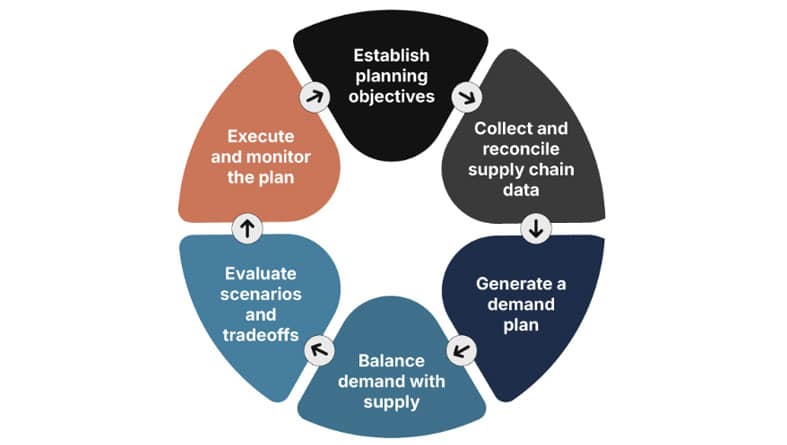
Supply Chain Planning Process Loop
Step 1: Establish Planning Objectives
Before starting any forecasting or data analysis, you need to decide what the supply chain planning process is trying to achieve. This means aligning finance, operations, logistics and key stakeholders around shared business objectives and the key performance indicators (KPIs) used to measure them. Many organizations formalize this alignment through a sales and operations planning (S&OP) cadence: a recurring cross-functional forum where these objectives are agreed upon and revisited as conditions change.
Common KPIs include:
- Service level: How consistently customer demand is fulfilled within the promised timeframe
- Inventory turns: How often inventory is sold over a given period
- Working capital: The amount of capital tied up in day-to-day operations
- Cost to serve: The total cost of fulfilling customer demand, including transportation, warehousing, handling and other fulfillment costs
- Forecast accuracy: How closely predicted demand matches actual demand over a defined period
- Capacity utilization: How much of the available production or operational capacity is being used
These metrics provide a common ground for evaluating planning decisions and understanding the trade-offs between competing priorities.
In this phase, you should also define the scope and planning horizon. For the scope, you should specify which products, locations, business units, suppliers or marketplaces are included in the planning cycle. A clear definition of these boundaries helps ensure that planning decisions are evaluated against the right constraints.
For the planning horizon, you may use different horizons for strategic, tactical and operational decisions. Planning cycles may range from months or years for network or capacity decisions to weeks or days for replenishment and production. The table below shows how planning horizons typically vary across operational, tactical and strategic decisions.
| Decision Type | Example | Planning Horizon |
|---|---|---|
| Operational | Transport planning, inventory deployment | Days |
| Tactical | Procurement strategies, order consolidation, capacity management | Weeks-Months |
| Strategic | Network optimization, business expansion | Years |
In short, longer horizons support higher-level decisions, while shorter horizons guide day-to-day execution.
Step 2: Collect and Reconcile Supply Chain Data
Once you’ve set your planning objectives, you need a reliable dataset to support the decisions that follow. Your planning process will typically rely on data from multiple systems, including:
- Enterprise resource planning (ERP) systems
- Spreadsheets
- Supplier portals
- Warehouse and transportation systems
- Point-of-sale (POS) feeds
Relevant inputs from these data sources can include demand history, inventory position, supplier lead times, production capacity, purchase orders, customer orders, transportation constraints and network information.
Because these data sources often differ in structure and format, they rarely give you a consistent and reliable picture of the end-to-end supply chain. Common issues include:
- Differences in product and location hierarchies between systems
- Inconsistent units of measure
- Missing, duplicated or outdated item codes
These are likely reasons why your team spends a significant amount of time reconciling spreadsheets and resolving discrepancies before they can begin analyzing the plan. Bringing this data together into one consistent and trusted dataset is often the most tedious and time-consuming part of the planning cycle. It’s also critical to get this right: if the issues are carried forward into the planning process, they can distort forecasts, create false constraints or lead you to make decisions based on outdated or wrong information.
Step 3: Generate a Demand Plan
Once you have a reliable, clean dataset, the next step is to develop a demand plan that estimates what customers are likely to purchase over the planning horizon. You can build this plan by:
- Building a statistical baseline forecast from historical demand, using methods such as moving average or exponential smoothing
- Incorporating machine learning to identify patterns across larger datasets and account for factors such as seasonality, product lifecycles and changes in demand behavior
- Accounting for known future events and demand drivers such as promotions, product launches, pricing changes and market conditions
- Identifying outliers, such as unusual spikes or drops in historical demand, that can distort the baseline forecast if treated as representative of future demand; rather than simply removing these observations, you should investigate their underlying causes and determine whether they are likely to recur
You should then review the resulting forecast with the stakeholders who have relevant market and customer knowledge, as sales, marketing, finance and supply chain teams may have information that is not captured in historical data. Combining the statistical forecast with these inputs helps establish a demand plan that you can use as a common planning assumption.
Step 4: Balance Demand With Supply
With an agreed demand plan in place, you can now compare expected requirements with what the supply chain can realistically support. This means accounting for service level targets, inventory availability, production capacity, supplier lead time, material constraints and other operational limitations. The goal is to identify potential supply gaps, surpluses and bottlenecks before they affect customer service.
For example, the figure below indicates that in the month of April, a product will require 26,000 units, while available inventory and planned production can cover only 21,000 units.
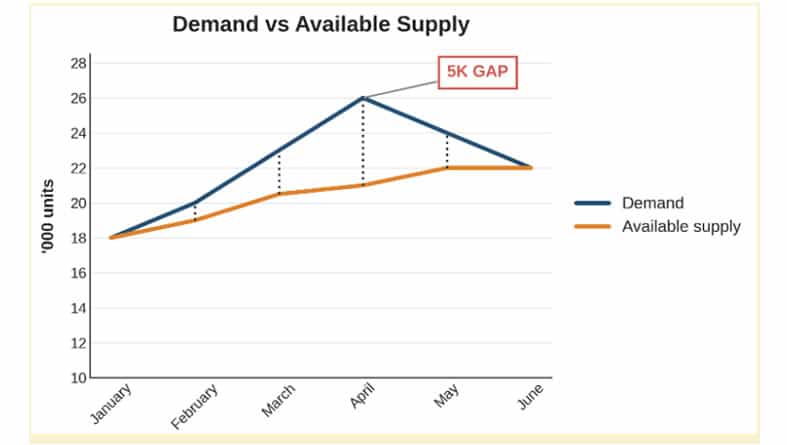
Balancing Supply and Demand
That 5,000-unit gap could be caused by:
- Insufficient production capacity
- A supplier constraint
- A longer-than-expected lead time
- Inventory positioned in the wrong location
At this stage, the goal is to understand where the plan is infeasible and why. You can then identify potential responses, such as adjusting production schedules, bringing purchase orders forward, reallocating inventory, changing sourcing decisions or re-prioritizing demand. These alternatives should be evaluated against the planning objectives and KPIs established earlier.
This analysis gives you a baseline plan that shows where demand and supply are aligned and where intervention may be required.
Step 5: Evaluate Scenarios and Trade-offs
Once you’ve identified potential gaps between demand and supply, you need to determine how best to respond. There is rarely a single solution. A shortage at one location, for example, could be addressed by:
- Sourcing from an alternative fulfillment center
- Reallocating inventory from another location
- Changing a production schedule
- Expediting shipment
- Using an alternative supplier
Each option can resolve the immediate constraint, but it can also create consequences elsewhere in the supply chain. Scenario planning allows you to evaluate these alternatives before committing to a course of action. You can change assumptions or constraints, such as supplier capacity and transportation routes, and assess how each scenario affects the overall plan. For example:
- Expediting a shipment might protect the service level but increase transportation costs and, as a result, reduce margin
- Reallocating inventory could avoid a stockout in one market but create a shortage in another
- Shifting production to resolve capacity constraints could increase changeover costs
The key is to evaluate the objectives established at the beginning of the planning process. Comparing these effects across relevant KPIs helps you see the full implications of each decision.
Step 6: Execute and Monitor the Plan
Once you’ve selected and approved a scenario, you need to translate the plan into operational actions. These can include:
- Releasing production schedules
- Generating, adjusting or expediting purchase orders
- Allocating inventory
- Booking transportation
- Updating distribution plans
The execution stage is where planning decisions begin to affect actual supply chain performance, so it’s important to maintain visibility into how the actual results compare with the original assumptions.
Monitoring performance creates a feedback loop for the next planning cycle. If actual demand, inventory, production or supplier performance diverges from the plan, you can identify exceptions and reassess your decisions. AI can support this process by helping identify exceptions, recommend actions and automate routine decisions within predefined guardrails. For example, you could establish rules for:
- When inventory should be replenished
- When a supplier should be considered for an order
- When a shipment should be rerouted
If conditions fall within those limits, an AI-enabled system can execute the decision automatically. If a decision has a larger financial, operational or customer impact or falls outside those guardrails, the system can flag it for your review.
The result is a continuous planning and execution loop rather than a linear process that ends when a plan is released. As conditions change, new information can feed back into the process, allowing you to retain control over complex decisions that require business context or human judgment while automating routine and repeatable decisions.
Turning Planning into Continuous Improvement
An effective supply chain planning process gives you a way to connect planning decisions from one stage to the next. Reliable data supports better forecasts, better forecasts provide a stronger basis for balancing supply and demand, and scenario analysis helps you choose how to respond to potential gaps. Actual results from execution provide new information that feeds back into the next planning cycle. When planning is connected across demand, supply, inventory and execution, organizations can respond to change faster while continuously improving their plans.
The right planning technology can help you:
- Anticipate disruptions: Monitor changing demand, supply and market conditions to identify potential issues early and evaluate alternative responses
- Continuously refine plans: Incorporate new data and execution results into the planning cycle so plans stay aligned with current conditions
- Make better decisions faster: Use AI-assisted planning to identify signals, evaluate scenarios, recommend actions and automate routine decisions within defined business rules
Aptean brings these capabilities together. Its supply chain planning solutions connect demand planning, supply planning, inventory optimization, S&OP and scenario analysis within a unified planning environment. These solutions can help your team move from identifying a potential issue to evaluating options and taking action more quickly and effectively. The result is not simply a better plan but a continuous, iterative learning process that adapts as conditions change, learns from execution and turns new information into better-informed decisions.
For more on how Aptean’s solutions can work for your business, contact us or request a demo.